


Maytag Washer Won't Drain: F21 and F9E1 Error Code Fix

Terry Okafor
Master refrigeration tech and NATE-certified instructor who moonlights as the magazine's advice columnist. His 'Ask Big Terry' mailbag has been settling shop disputes and diagnosing mystery leaks since 2011.
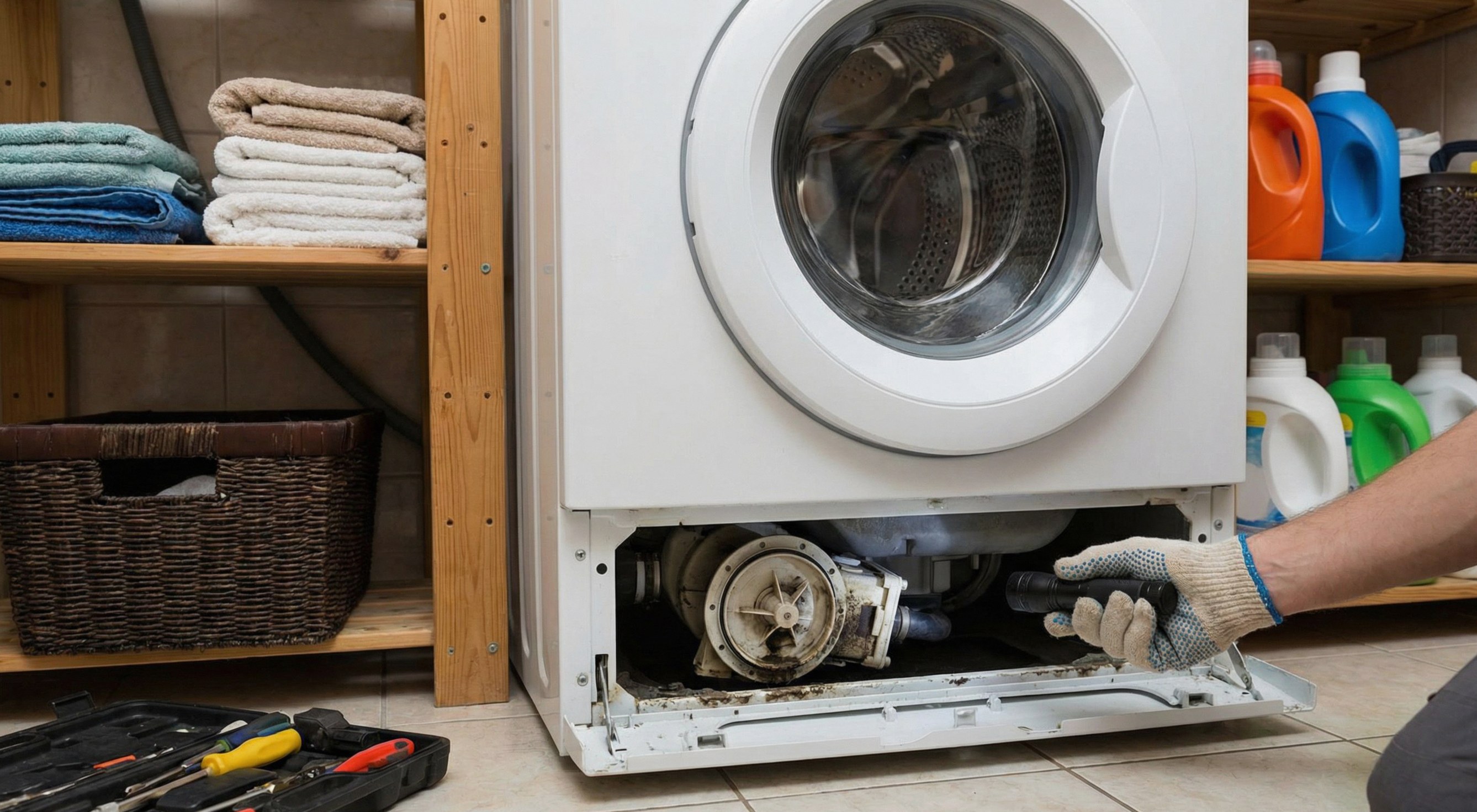
A Maytag washer not draining is one of those calls that's either a five-minute coin trap cleanout or a two-hour diagnostic headache. There's not much in between. The F21 error code — and its newer cousin F9E1 on Maytag models running the updated control platform — both mean the same thing: the control board started a drain cycle and the water level didn't drop fast enough. Specifically, the machine couldn't pump down within about eight minutes.
I see this most on the Maytag Maxima and Performance series front-loaders: the MHWE200, MHW5500, MHW6000, and MHW8630. These are all Whirlpool-platform machines, so if you've worked on Whirlpool Duet draining problems, the diagnostic path will feel familiar. But there are enough Maytag-specific quirks to make this worth walking through on its own.
Here's the full rundown, from the most common fix to the rare stuff.
Start With the Coin Trap (Drain Pump Filter)
Eighty percent of F21 calls end here. The coin trap — Maytag calls it the drain pump filter — sits at the front bottom of the machine behind a small access panel or the lower kick plate. On the MHW5500 and MHW6000, it's behind a round cover on the lower right. On the MHWE200 and older Maxima units, you'll need to pop off the entire lower panel.
Before you open it, get towels down. Lots of them. The tub is full of water, and it's all coming out the front when you pull that filter. On second thought, skip the towels and use a shallow baking pan or a wet-dry vac with the hose held right at the filter housing.
Unscrew the filter counterclockwise. Pull it straight out. You will find things in there. Bobby pins, coins, small socks, bra underwires, dog toy squeakers — I once pulled a full set of car keys out of an MHW6000. The customer had been looking for them for three months.
Clean the filter, inspect the impeller cavity behind it (spin the impeller by hand — it should turn freely), reinstall, and run a drain cycle. If the water pumps out and the code doesn't return, you're done. Bill for the service call and move on.
Tell every customer to check the coin trap every three months. It takes 60 seconds. This one habit prevents most F21 calls entirely. Some techs leave a reminder sticker on the inside of the access panel door — it's a small gesture that cuts repeat calls and builds trust.
Drain Pump Motor Failure
If the coin trap is clean and the impeller spins freely but the washer still won't drain, test the pump motor. Kill power at the outlet or breaker first.
The drain pump on these Maytag front-loaders is mounted to the bottom of the tub, accessible from the front once you remove the lower panel. Disconnect the two-wire harness from the pump and check resistance. You want 5 to 15 ohms across the terminals. An open reading means the winding is burned out. A reading to ground (either terminal to the pump housing) means insulation breakdown. Either way, the pump is done.
But here's the thing — a pump can read fine on resistance and still be bad. The impeller can separate from the motor shaft internally. You'll hear the motor hum when it gets voltage, but nothing moves. Or the impeller cracks and freewheels. The motor turns, the impeller doesn't, no water moves. I've been burned by this one. If you hear the pump running but water isn't moving and the drain path is clear, pull the pump and eyeball the impeller connection.
The standard replacement pump for most of these models is the W10730972. On the newer MHW8630 and some late-run MHW6000 units, you'll see the updated W11458345 — same footprint but improved impeller and seal design. Always cross-reference against the model and serial number. Reliable Parts and Encompass both have good cross-reference tools for this, and if you've built up a local parts supplier relationship, they can usually get either pump to you same-day in the SoCal market.
When you pull the drain pump, check the pump housing for scoring or cracks. A scored housing lets water seep past the impeller instead of being pushed through the outlet. If the housing is damaged, replace the full assembly rather than just the motor. The $15 difference saves you a callback.
Drain Hose Problems: Routing, Height, and Standpipe Issues
The drain hose on a Maytag front-loader needs to meet specific installation requirements. When those requirements aren't met, you get intermittent F21 codes that drive everyone crazy because the pump works, the coin trap is clean, and the washer drains fine — sometimes.
Three things to check:
Hose height. Maytag's installation spec calls for the drain standpipe to be at least 39 inches high and no higher than 96 inches. Too low and water siphons back into the tub during the wash cycle, confusing the water level sensor. Too high and the pump can't push water up to the outlet. I've measured drain hoses on service calls that were jammed straight into a floor-level pipe with zero rise. The washer drained fine until the pump weakened slightly with age, and then the F21 started showing up.
Standpipe diameter. Maytag's drain system is designed around a standard 1.5-inch (1-1/2 inch) drain. A standpipe that is partially clogged, shared with other drainage, or otherwise restricted can still create enough back pressure to slow drainage past the control board's timeout threshold. This is an installation issue, not a washer issue, but you need to flag it for the customer.
Kinks and restrictions. Pull the washer out and trace the entire hose run. Kinks happen when the washer gets pushed too far back against the wall, especially on the MHW5500 where the hose exits low on the back panel. Even a partial kink can halve the flow rate. If the hose is kinked and the outer wall is creased or cracked, replace the hose — a creased hose will re-kink at the same spot.
The diagnostic clue for hose problems: the washer drains slowly but does eventually empty if you let it run long enough. A dead pump produces zero drainage. A hose restriction produces slow drainage. The F21 code fires because the pump-down exceeded eight minutes, not because zero water moved.


When the Maytag Washer Won't Drain: Pressure Switch and Air Dome
This is where the diagnostic gets less intuitive. The pressure switch tells the control board how much water is in the tub. It does this through a small rubber tube — the air dome hose — that connects from the bottom of the outer tub to the pressure switch mounted on the frame. As water fills the tub, air pressure in the tube increases and trips the switch at calibrated levels.
If that tube is cracked, kinked, or disconnected, the pressure switch can't accurately read the water level. The board might think the tub is still full even after the pump has emptied it. Result: F21 code, even though the washer actually drained fine.
To test: locate the pressure switch (top of the machine, near the back right corner on most models). Pull the air dome hose off the switch and blow gently into it. You should feel zero resistance and hear bubbling down at the tub. If it's blocked, replace the hose. If the hose is clear, test the switch itself with a multimeter — apply gentle air pressure (just blow into the hose port on the switch) and confirm the contacts change state.
The air dome hose is a $12 part. The pressure switch runs $30-45. Both are simple swaps.
On the MHWE200 and early MHW5500, the air dome hose runs behind the inner tub and can get pinched against the frame during shipping or if the machine was moved. If you're on a call where the washer was recently delivered or relocated and is throwing F21, check that hose routing first.
Control Board — The Expensive Diagnosis
It doesn't happen often, but the main control board (CCU) can fail in a way that specifically kills the drain cycle. The relay that sends 120V AC to the drain pump burns out. Everything else works — fill, agitate, spin — but the drain relay contacts are welded open.
Test for this by starting a drain cycle and checking for 120V AC at the pump connector. If the pump is good but gets no voltage during drain, the board isn't firing the relay.
The board for most of these models is the W10480169 (verify the current replacement/successor part number against the model and serial before ordering). It sits inside the main control housing at the top back of the machine. Swap is straightforward — unplug connectors, remove mounting screws, transfer the board to the existing housing, reconnect. Takes about 30 minutes.
But before you quote a $200+ board, double-check your pump diagnosis. I've seen techs jump to the board when the real problem was a mechanically failed pump that tested fine electrically. Try running 120V directly to the pump from a test cord (with appropriate safety precautions). If the pump runs strong on direct power, then yes, it's the board.
Model-Specific Notes
MHWE200 / MHWE201 (Maxima): The oldest of this platform. These have a smaller-diameter drain hose than the later models, which clogs more easily. The coin trap housing is also slightly different — make sure you're ordering the right filter cap if it needs replacement. The pump is the same W10730972.
MHW5500 / MHW5100: The workhorse models still in heavy field rotation. These introduced the F9E1 code alongside the legacy F21. Both codes mean the same thing. The pump access is easier on these — single panel, no screws on some production runs (just clips).
MHW6000: Higher-spec model with a larger tub. The extra water volume means the pump works harder per cycle. I see more pump motor failures on the MHW6000 than on the 5500, probably just because it's pushing more water through the same pump. Consider quoting the upgraded W11458345 pump for these.
MHW8630: The newest platform in this family. Uses the W11458345 pump standard. The control board is a later revision (confirm the current part number against the model and serial). The F9E1 code uses the same roughly 8-minute long-drain threshold as F21.
If you're running these diagnostics and still hitting a wall, it's worth noting that Whirlpool-platform drain systems share a lot of DNA. The diagnostic logic transfers. The pumps, boards, and pressure switches are different parts, but the failure modes are the same.
Clearing the Code and Confirming the Fix
After you've addressed the root cause, unplug the washer for 60 seconds. Plug it back in and run a Drain & Spin cycle. Watch the full cycle. If it drains completely with no code, you're good. Run it a second time to be safe — intermittent clogs can clear on the first attempt and return on the second.
If the code comes back immediately, you've missed something. Go back to the beginning. In my experience, the most common "missed something" is a second obstruction in the coin trap that wasn't visible with the first object in the way, or a cracked impeller that seems to spin fine by hand but can't handle the load under water pressure.
What does the F21 error code mean on a Maytag washer?▾
F21 means the control board detected a long drain time — the washer couldn't empty within 8 minutes. Common causes are a clogged drain pump filter (coin trap), a failed drain pump motor, a kinked drain hose, or a stuck item blocking the impeller.
How do I clear the F21 code on my Maytag washer?▾
First fix the underlying drain problem. Then unplug the washer for 60 seconds and plug it back in. The code will clear on the next successful drain cycle. Do not just reset the code without fixing the cause — the tub may still be full of water.
How much does a Maytag drain pump replacement cost?▾
The drain pump assembly (W10730972) runs $50-80 for the part. With labor, expect $175-275 total. Cleaning the coin trap alone is typically a $100-150 service call.
Need a repair professional?
Get free quotes from verified technicians in your area.
Find a Pro Near You