


Oven Not Heating: Complete Diagnostic Guide for Gas and Electric Ovens

Terry Okafor
Master refrigeration tech and NATE-certified instructor who moonlights as the magazine's advice columnist. His 'Ask Big Terry' mailbag has been settling shop disputes and diagnosing mystery leaks since 2011.
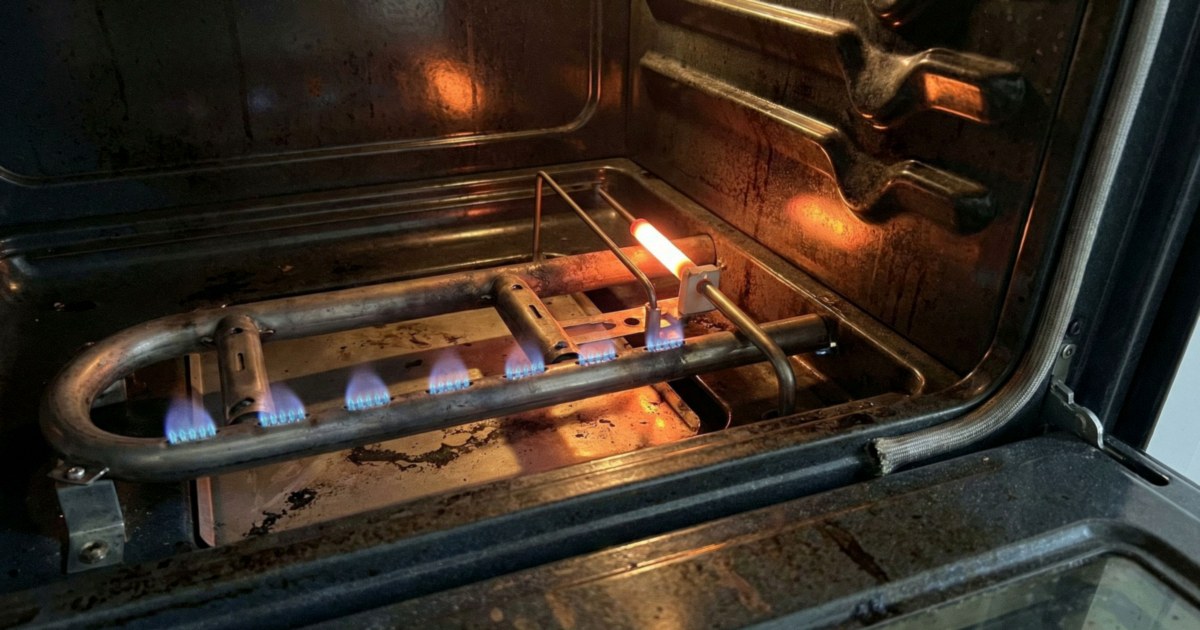
An oven that won't heat is a straightforward diagnosis once you understand how the heat circuit works. Gas and electric ovens operate on completely different systems, so I'll cover them separately. But I'll say this upfront: on gas ovens, the igniter is the most common culprit by a wide margin. On electric ovens, it's the bake element. Start there, work outward.
Gas Ovens: How the Heating Circuit Works
A gas oven ignition system has four main components: the oven igniter, the gas safety valve, the oven thermostat (or electronic temperature sensor), and the control board (on electronic models). Understanding how they interact explains why the igniter fails the way it does.
When you call for heat, the control board or thermostat sends power to the oven igniter. The igniter glows. As it heats, it draws more current. When it draws enough current — typically 3.2 to 3.8 amperes — the bimetal safety valve opens and gas flows to the oven burner. The hot igniter lights the gas. The burner heats the oven. When the target temperature is reached, the control cuts power to the igniter and valve, the flame goes out.
An igniter that's too weak won't draw enough current to open the valve. It glows — sometimes brightly — but the gas never flows. This is why a glowing igniter does not mean a good igniter. You have to meter the current draw to confirm.
Step 1: The Gas Oven Igniter
The igniter is a silicon carbide or silicon nitride element shaped like a flat bar or round rod, mounted in the oven burner assembly at the bottom of the oven cavity. On most ranges, accessing it requires removing the oven floor panel (usually two screws) and the bottom burner cover.
Visual inspection first: A cracked, broken, or physically damaged igniter is condemned. Replace it. Don't waste time metering a snapped element.
Current draw test: Pull the range forward to access the back panel, or use a clamp-on ammeter on the igniter supply wire. Start a bake cycle and let the igniter begin to glow. Measure current:
- 3.2A or higher → igniter is good, valve or wiring is the problem
- 2.0A to 3.2A → igniter is weak. It may light occasionally but will fail progressively
- Under 2.0A → igniter is failing. Replace it.
Part numbers by brand:
- Whirlpool/Maytag/KitchenAid (most models) — 12400035 (flat-style oven igniter kit, fits most Whirlpool-family freestanding ranges)
- GE/Hotpoint — WB13K21 or WB2X9998 depending on generation. GE uses a round glowbar style on older models; flat bar on newer builds.
- Samsung (NX58/NX60 series) — DG94-00520A. Samsung flat igniter, specific to their freestanding gas ranges. Match the model number.
- LG (LRG series) — MEE61841401. LG uses a flat glow-bar style on most of their freestanding ranges.
- Frigidaire/Electrolux — 316489400 or 5304527765 depending on model year. Frigidaire igniters have a relatively high failure rate on their mid-range gas ranges — stock this one if you service Frigidaire frequently.
GE gas oven igniters glow orange-yellow when healthy and drawing full current. If you see a dim, red-orange glow that never brightens, that's a weak igniter — even if it hasn't broken. The test is current draw, not color, but color is a fast field indicator. A healthy igniter in a dark oven glows noticeably bright. A dying one looks like a lazy ember.
Step 2: The Oven Safety Valve (Gas)
If the igniter draws 3.2A or higher but the gas doesn't light, the safety valve is the problem. The safety valve is an electromechanical device that only opens when the igniter's current draw proves the igniter is hot enough to safely ignite gas. No flame from a known-good igniter = failed valve.
The oven safety valve is typically mounted on the gas manifold behind the rear panel of the range. On most brands, the igniter and valve are a matched pair from a resistance perspective — if you're replacing one, check if the other is in spec.
Safety valve part numbers:
- Whirlpool — WP9782069 (fits most WP-family gas ranges)
- GE — WB19K10043 or WB19K23 depending on generation
- Samsung — DG94-00028A
- LG — MEE63378901
- Frigidaire — 316116202
The valve itself costs $45-90 depending on brand. Labor is $150-200 because the rear panel access adds time over the igniter swap.
Step 3: Gas and Electric Ovens — Temperature Sensor
Both gas and electric ovens use an oven temperature sensor (also called an RTD — resistance temperature detector) to monitor cavity temperature and signal the control board. A failed or out-of-spec sensor can cause no-heat, overheating, or erratic temperature.
The sensor is a narrow probe, usually 1/4-inch diameter, mounted at the upper rear interior of the oven cavity. Two screws secure it, and a wiring harness connects at the back.
Testing the sensor:
- Unplug the range (or flip the breaker for built-in ovens)
- Remove the sensor probe from the oven cavity (two screws)
- Disconnect the wiring harness
- Measure resistance across the sensor terminals at room temperature
Resistance specifications:
- Most brands: 1,080-1,100 ohms at 70°F
- LG: 1,060-1,080 ohms at 70°F (slightly different spec)
- Samsung: 1,100-1,115 ohms at 70°F
An open reading (OL) = failed sensor. A resistance reading well outside the spec range = failed sensor. A reading within spec but with physical damage visible on the probe = replace it anyway.
Sensor part numbers:
- Whirlpool/Maytag — WPW10131825
- GE — WB21X5301 (most freestanding), WB21T10007 (built-in wall oven)
- Samsung — DG32-00002B
- LG — 6322B07890 (LRE/LTG freestanding series)
- Frigidaire — 316217002
A temperature sensor that reads in-spec at room temperature can still fail at operating temperature — the resistance/temperature curve shifts when the ceramic element cracks internally. If a sensor tests good cold but the oven consistently under-heats or over-heats and you've eliminated everything else, replace the sensor. It's a $15-25 part. I've solved more than a few mystery temperature complaints this way.
Electric Ovens: How the Heating Circuit Works
An electric oven has a bake element (bottom of the cavity), a broil element (top of the cavity), and a temperature sensor. The control board monitors temperature via the sensor and cycles the elements to maintain the set temperature. On older mechanical models, the thermostat does the same job without electronics.
When only bake is affected and broil works, the bake element or its circuit is the problem. When both fail, look at the power supply (breaker, wiring) or the control board.


Step 1: The Bake Element (Electric)
The bake element is a coiled resistance wire inside a protective sheath, mounted on the oven floor. It's the most replaced part on electric ranges — and the most visible when it fails. A failed bake element usually shows physical damage: a crack, blister, hole, or burn-through spot. Most failed elements show visible damage, but some look perfectly fine and only reveal the failure when you test them open with a meter — so never skip the resistance check.
Testing the bake element:
- Turn off the breaker or unplug the range
- Remove the two mounting screws at the back of the element (inside the oven)
- Pull the element forward, disconnect the two wires
- Test resistance across the terminals — a healthy element reads 10-50 ohms
- Open reading = failed element. Also test each terminal to the element housing (ground) — any reading indicates a short to ground
Bake element part numbers:
- Whirlpool/Maytag — WP9755770 (lower bake element, fits many Whirlpool-family ranges and ovens)
- GE — WB44T10011 (most freestanding ranges), WB44X5082 (Profile/Cafe series)
- Samsung (NE58/NE63 series) — DG47-00040A
- LG (LRE series) — EBF61315801 or MEE63384401 depending on wattage
- Frigidaire — 316075104
Step 2: The Broil Element (Electric)
The broil element is at the top of the oven cavity. Test it the same way as the bake element — resistance check, shorts to ground. Most broil elements run 2,500-3,500 watts, so resistance will be lower (around 8-25 ohms).
A broil element failure that's combined with a working bake element points to a failed broil relay on the control board, a failed high-limit thermostat on some models, or the element itself. Isolate the element before condemning the board.
Step 3: The Control Board (Electric and Gas Electronic)
On any modern range with electronic controls, the control board manages the heating circuit. Relay failures on the board are the most common board fault — look for burned contacts or scorch marks near the relay cluster.
On electric ranges, the control board relay switches high voltage (240V) to the elements. Failed relay = no element power. Unlike the dryer, you can sometimes hear the relay click when it operates. No click = failed relay or no signal from the control software.
On gas ranges with electronic controls, the board controls the igniter circuit and reads the temperature sensor. Board failures present as no igniter power or erratic temperature behavior despite a good sensor.
Approach: Rule out every other component (igniter, element, sensor, power supply) before condemning the board. Boards are expensive and occasionally misidentified as failed when a cheap sensor or element is the actual problem.
Step 4: The Power Supply Check (Electric)
Before condemning any electrical component on an electric range, check the power supply. Electric ranges run on 240V with two legs of 120V each. If one leg of the breaker trips (which looks like the breaker is on), the range gets 120V to one side of the bake element circuit.
Symptom: The oven and surface burners still have some functions (clock, surface lights) but the bake element won't heat. The breaker looks normal.
Test: Meter the outlet with a voltmeter. You should see 240V between the two hot legs, and 120V from each hot to neutral. If you see 120V across the two hot legs, one breaker leg has tripped. Reset the breaker fully (off, then on), then retest.
Quick-Reference Diagnostic Summary
Gas oven not heating:
- Igniter — current draw test. Replace if under 3.2A
- Safety valve — replace if igniter is good but no flame
- Temperature sensor — resistance test, 1,080-1,100 ohms at room temp
- Control board — last resort after everything else clears
Electric oven not heating:
- Bake element — resistance test and visual inspection
- Power supply — 240V check at the outlet
- Temperature sensor — same resistance test as gas
- Control board — relay inspection after everything else rules out
For related reading, our dryer not heating guide covers similar thermal fuse and heating element diagnostics for dryers — similar principles, different components.
Why is my gas oven not heating but the stove burners work?▾
The stovetop and oven use separate ignition systems. Working burners on the cooktop confirm gas supply to the range, but say nothing about the oven igniter or safety valve. A failed oven igniter is the most likely cause — test current draw while the igniter is energized. Below 3.2A while glowing means the igniter is too weak to open the safety valve.
How do I test my oven temperature sensor?▾
Unplug the range, remove the sensor probe from the oven rear wall (two screws), disconnect the harness, and measure resistance across the two sensor terminals. At room temperature (70°F), most oven sensors read 1,080-1,100 ohms. An open reading or a reading significantly outside this range means replace the sensor.
How much does it cost to replace an oven igniter?▾
The part runs $20-45 depending on brand. Labor is typically $100-150, making total repair cost $125-200. This is one of the better repair values in appliance service — cheap part, clear diagnosis, reliable fix. On most ranges the igniter is accessible in under 30 minutes once the oven floor panel is removed.
My oven heats sometimes but not consistently. What's wrong?▾
Intermittent heating on a gas oven is usually a weak igniter — one that draws borderline current and sometimes opens the safety valve, sometimes doesn't. On electric ovens, intermittent heating often points to a partially failed bake element (look for crack or blister) or a failing temperature sensor. Also check the relay on the control board — an intermittently failing relay produces exactly this symptom and is harder to catch.
Need a repair professional?
Get free quotes from verified technicians in your area.
Find a Pro Near You