


Scaling From Solo Tech to Multi-Truck: The Hardest Transition in This Business
Maria Solano
Former appliance warranty claims adjuster turned investigative repair journalist. Maria's 'What Went Wrong' teardown series has made her the most feared woman in the white-goods industry.
I've interviewed more than 40 appliance repair shop owners over the past several years for ServiceMag. The question I ask every owner who has successfully scaled past three vans is: "What was the hardest part?" The answer is almost universally the same: the transition from tech to manager.
Not the hiring. Not the trucks. Not the insurance. The fundamental identity shift from "I fix appliances" to "I run a business that fixes appliances." It sounds simple. It is not.
This guide covers the financial and operational benchmarks for scaling readiness, how to restructure operations for a multi-truck shop, dispatching systems, customer relationship management during growth, and quality maintenance when you're not on every call.
The companion guides — starting an appliance repair business in California and pricing for Southern California appliance repair — cover the foundations this guide builds on.
Revenue Benchmarks: Are You Actually Ready?
The Financial Readiness Check
Before you hire a second tech, run these numbers:
Minimum revenue threshold: You should be consistently generating $15,000-18,000 per month in billings as a solo tech, not as a one-month anomaly but as a 3-4 month trend. This level demonstrates market demand strong enough to support a second revenue-producing employee.
Booking backlog: You should be booked out 2-3 weeks consistently. A 2-week backlog is the market telling you it wants more of what you offer. If you're booking 3-4 days out, you have capacity — you don't have a scaling problem.
Profit margin check: Gross margin on solo tech work in Southern California should be running 55-65% (revenue minus direct job costs: parts, tech labor on piece-rate if applicable, vehicle costs). If you're below 50% as a solo tech, scaling will amplify the margin problem, not fix it. Solve the margin before you add headcount.
Cash reserve: You need 3 months of the new tech's all-in cost in reserve before you hire. All-in cost for a second tech: base pay or piece rate ($18-26/hour or 35-45% of billings), employer FICA and payroll taxes (8-10% on top of wages), workers' comp insurance ($10-15 per $100 of payroll for appliance tech classification), and the vehicle cost if you're adding a truck. Total: $5,500-9,000/month. Three months reserve: $16,500-27,000. If you don't have this, a slow month becomes a crisis.
The Operational Readiness Check (Often Skipped)
Financial readiness gets measured. Operational readiness usually doesn't — until the new hire is already on the road and things start going wrong.
Before you hire, answer these honestly:
- Do you have written processes for how jobs are booked, confirmed, dispatched, and closed? If the process is "I know what I'm doing," that's not scalable.
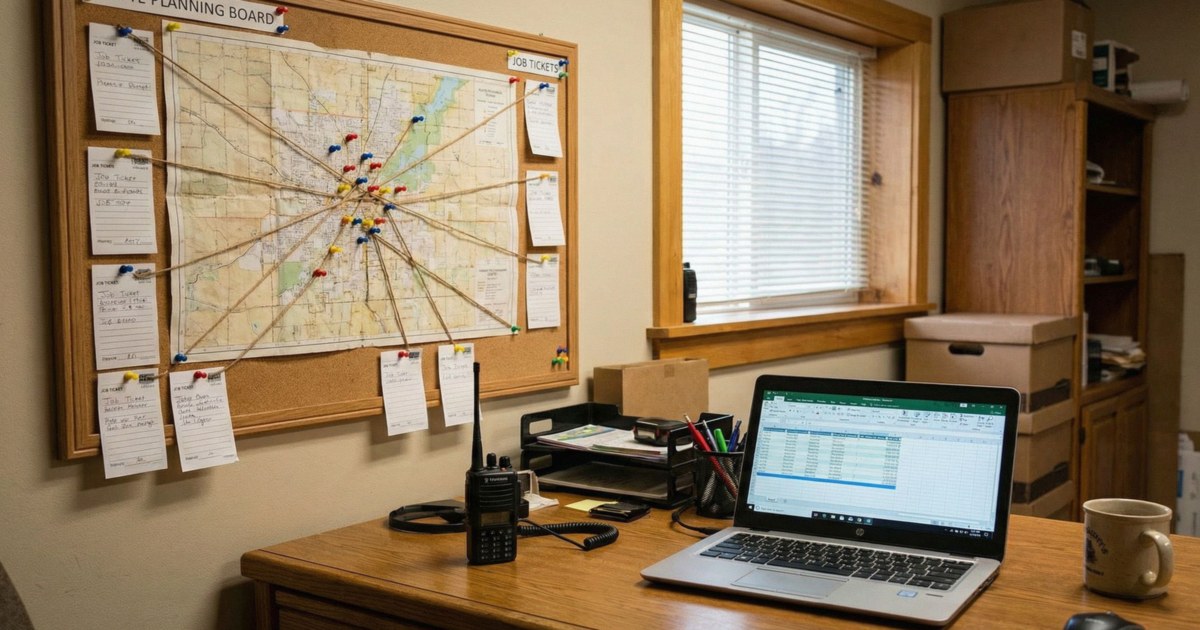
- Do you have a dispatch system that shows jobs, techs, and availability on a screen? Or are you doing it from memory/text messages?
- Can you define "quality" in your shop in objective terms? (e.g., "Every job closed with a test run, photo in the job record, and customer sign-off")
- Do you have a way to review completed work without being on the call? (Job notes, customer call-backs, follow-up surveys)
If you can't answer yes to at least three of these, fix them before you hire. Otherwise you'll spend your management time firefighting instead of growing.
The Identity Shift: From Doing Work to Managing Work
This is where most solo techs struggle most. They're excellent at fixing appliances. They're starting from zero at managing people. These are different skills, and the instinct when things go wrong is to go back to doing the work yourself.
What "Managing Work" Actually Means
Managing a multi-tech shop means:
- Setting standards: Defining what a good job looks like, what communication with customers sounds like, what "done" means on a service call
- Reviewing results: Looking at completed job records, customer feedback, and callback rates to find patterns — not judging individual mistakes, but identifying systemic issues
- Coaching, not rescuing: When a tech calls you from the field because they're stuck, your instinct is to drive out there and fix it. The right move is to coach them through it over the phone. Driving out does the job faster but teaches nothing and makes you the emergency option forever.
- Administrative work that you never had to do before: Payroll, scheduling, billing follow-up, parts ordering across multiple vehicles, insurance certificates, contractor license renewal
A realistic time budget for a 2-tech shop owner who has exited the field: 20% reviewing and coaching, 20% admin, 20% customer relationship management and business development, 20% dispatch, 20% strategic (pricing, marketing, vendor relationships). If you're still running calls, add that on top — but know that each day in the field is a day your management work doesn't get done.
The owner who holds onto the premium calls — "I'll do the Sub-Zero calls myself, Marcus handles the Whirlpools" — is not building a business. They're building a two-person shop where one person (them) is the limiting resource. Every call you keep for yourself because you think no one else can do it as well is a training opportunity you're hoarding. Your job is to make Marcus as good at Sub-Zero calls as you are, not to be irreplaceable on them.
Dispatching Systems: What You Need and When
Phase 1: Solo Tech (1 Van)
At the solo level, a shared Google Calendar, a separate Google Voice number, and a Stripe/Square account for payments is a functional minimum. You're doing your own dispatching. Total monthly cost: essentially zero.
Phase 2: 2-3 Techs
At two techs, you need dedicated service management software. The requirements:
- Job scheduling with tech assignment
- Customer contact and history
- Invoicing and payment collection
- Basic route view (where are my techs right now)
Housecall Pro is the most popular choice at this size: $65-150/month, clean mobile app for techs, solid customer communication automation. Jobber is the closest alternative with a slight edge on customization.
At this phase, you or an office admin (part-time initially) handles dispatch. The question of "which tech goes to which job" can still be managed manually when you have two techs and 8-15 jobs per day.
Phase 3: 4+ Techs
Manual dispatch breaks at four techs. You're managing 30+ daily jobs across four different locations, all trying to optimize route, skill match (some jobs need more experience), and customer time window commitments simultaneously. This requires route optimization software.
ServiceTitan is the industry standard for appliance repair shops at this size. At $200-500/month (pricing is negotiated per seat), it includes:
- Automated route optimization
- Customer portal (customers can reschedule without calling)
- Tech mobile app with job details, parts lookup, invoicing
- Business analytics dashboard (revenue per tech, first-call completion rate, average ticket)
- Marketing automation (service reminders, follow-up emails)
The ROI case for ServiceTitan: if it enables your dispatch person to handle 20% more jobs per day across four techs by reducing scheduling conflicts and drive time, that's roughly one additional job per tech per day — $150-200 in additional daily revenue per tech. Monthly impact: $2,400-3,200 in additional billings. The software cost is $200-500/month.


The "They Want YOU" Problem
The most common emotional barrier to scaling is the customer who specifically wants the owner tech. You've built a reputation on your personal expertise. Some customers have been with you for 10 years. They call you. They want you.
This is a real business problem, not an ego problem. It reflects genuine customer loyalty and genuine quality concerns about an unknown new hire. Here's how to manage it:
The Transition Protocol
Step 1: Introduce new techs on co-calls. When onboarding a new hire, spend 2-3 weeks running calls together. You diagnose, they observe. Then they diagnose, you observe. Your top repeat customers meet the new tech while you're still present.
Step 2: Route callback and warranty work to the new hire first. Lower-stakes calls where the customer is already satisfied build the new tech's confidence and the customer's familiarity without the pressure of a first diagnosis call.
Step 3: Proactively communicate with your top 20 accounts. A quick call or text to your best property manager clients: "We're expanding this year. I want you to know that any tech I send carries our full service guarantee. If there's ever a concern, you call me." Most will appreciate the communication more than they'd miss the specific tech.
Step 4: Incentivize customer loyalty to the shop, not to you personally. Loyalty programs, multi-unit discount agreements, and proactive service outreach are all shop-branded, not owner-branded. The customer's relationship should be with your business.
The Service Guarantee
Offer (and honor) a service guarantee: if a customer is not satisfied with a repair performed by any tech in your shop, you personally review the job and make it right at no additional charge. This removes the risk from the customer's perspective and gives them a reason to trust a tech they haven't worked with before.
Quality Maintenance Without Being on Every Call
Quality control in a multi-tech shop has to be systematic, not supervisory. You cannot ride along on every call, and you shouldn't need to.
Define Quality Objectively
Every tech in your shop should understand what a completed job looks like. Define it:
- Repair tested with a full cycle (dryer runs for 20 minutes, refrigerator reaches target temp, etc.)
- Job notes include symptom, diagnosis, part number replaced, and test result
- Before/after photos in the job record (before: the failed component; after: installed new part)
- Customer signs off on completed repair OR tech documents reason for no-signature (commercial account, unattended entry, etc.)
Undocumented jobs create liability and callback confusion. A tech who says "I fixed it" with no photo, no part number, and no test result gives you nothing to defend when the customer calls three weeks later.
Review First-Call Completion Rate Per Tech
Track the percentage of jobs completed in a single visit versus jobs requiring a callback (second visit, different issue, or parts not on truck). First-call completion rate is the most important quality metric in field service. Industry benchmark for experienced appliance techs: 85-92% first-call completion.
A tech running at 70% first-call completion is either under-stocked, under-trained, or rushing. Any of those is fixable with specific coaching. A tech you're not tracking may be at 65% first-call completion while you think they're doing well because customers aren't calling to complain (yet).
Customer Feedback Loop
Set up an automated post-job text or email survey. One question is enough: "On a scale of 1-10, how satisfied were you with your recent service from [Shop Name]?" Anything below 7 triggers an automatic owner notification and a personal follow-up call.
Most service businesses that implement this catch 80% of dissatisfied customers before they become negative reviews. The ones you reach and make right become your most vocal advocates, because they experienced your commitment to service after a problem.
The Metrics That Tell You It's Working
Measure these monthly once you have two or more techs:
- Revenue per tech per day (target: $600-900 for appliance repair in SoCal)
- First-call completion rate per tech (target: 85%+)
- Average job ticket (track trends — a declining ticket is often a sign of tech under-selling or parts issues)
- New customer acquisition vs. repeat customer ratio (healthy business: 50-60% repeat)
- Customer acquisition cost (what you spend on marketing divided by new customers acquired)
- Net Promoter Score or satisfaction score (from your post-job survey)
A business that grows revenue while maintaining quality metrics is scaling correctly. A business that grows revenue while first-call completion drops and satisfaction scores fall is paper growth that will contract.
The transition from solo tech to multi-truck is the inflection point that determines whether you build a business or remain a self-employed technician who happens to have helpers. The distinction is not about how many vans are on the road — it's about whether the business can operate and grow without you personally performing every repair.
When is a solo appliance repair tech ready to hire a second technician?▾
The financial benchmark is being consistently booked 2-3 weeks out with monthly revenue above $15,000-18,000 for 3-4 consecutive months. At that level, a second tech generating $8,000-10,000 in monthly billings covers their cost and adds net profit. The harder readiness question is operational: do you have documented processes, a dispatch system, and quality checkpoints that don't require your personal presence on every call? Both conditions need to be true.
How do I handle customers who only want to work with me personally?▾
Introduce new techs on co-calls so your loyal customers meet them while you're present. Route warranty callbacks and lower-stakes jobs to the new hire first. Proactively contact your top 20 accounts to explain the expansion and offer a personal guarantee: any dissatisfied customer gets a direct review from you. Incentivize customer loyalty to your shop brand through loyalty programs and service agreements, not to you as an individual tech. Most customers care about responsiveness and quality — not specifically who does the repair.
What dispatching system should a growing appliance repair shop use?▾
For a 1-3 tech operation, Housecall Pro or Jobber provide adequate scheduling, dispatching, and invoicing at $65-175/month. For 4+ techs with serious dispatch volume, ServiceTitan is the industry standard at $200-500/month — it includes route optimization, customer communication automation, and business analytics. The ROI is straightforward: better routing enables one additional job per tech per week, which more than covers the software cost at current Southern California repair rates.
Need a repair professional?
Get free quotes from verified technicians in your area.
Find a Pro Near You