


Sealed System Repair: EPA Certification, Brazing, and When to Walk Away
Terry Okafor
Master refrigeration tech and NATE-certified instructor who moonlights as the magazine's advice columnist. His 'Ask Big Terry' mailbag has been settling shop disputes and diagnosing mystery leaks since 2011.
Sealed system work is where the appliance repair trade and the refrigeration trade overlap. It requires skills and certifications that go beyond the standard appliance diagnostic toolkit, and it carries legal obligations that don't apply to any other work in our field.
This guide is written for experienced techs who are evaluating whether to expand into sealed system work, and for techs who are already doing it but want a clear framework on when to proceed and when to walk. I'll cover the legal requirements first — because getting this wrong has real consequences — then the technical process, then the referral criteria.
EPA Section 608: The Legal Framework
Section 608 of the Clean Air Act prohibits the knowing release of refrigerants during the service, maintenance, repair, or disposal of appliances that use Class I or Class II refrigerants. This includes virtually every household refrigerant you'll encounter: R-12, R-22, R-134a, R-410A, R-404A, and R-32.
Certification requirements:
- Type I — small appliances (sealed hermetic systems charged with 5 lbs or less). Covers window ACs, dehumidifiers, household refrigerators.
- Type II — high-pressure equipment (R-22, R-410A, R-502). Covers central AC, heat pumps, most HVAC equipment.
- Type III — low-pressure equipment (R-11, R-113, R-123). Centrifugal chillers. Rarely encountered in appliance repair.
- Universal — covers all types. This is what most working refrigeration techs carry.
For household refrigerators specifically, Type I covers the regulatory minimum. But if you're going to do sealed system work across the full range of appliances — refrigerators, commercial reach-ins, HVAC equipment — get Universal.
The exam is offered through EPA-approved certification programs. ESCO Institute, NATE, and Mainstream Engineering are major providers. The exam costs $20-60, is 100 questions, and the material is available in study guides. A serious tech who spends a weekend studying passes on the first attempt.
The refrigerant purchasing requirement: Under EPA's November 18, 2016 final rule, which extended the Section 608 refrigerant management program (including the sales restriction) to HFCs such as R-134a and R-410A, you need Section 608 certification to purchase covered refrigerants. The only general small-can exemption is for motor vehicle air conditioning (MVAC): small cans of non-exempt MVAC refrigerant designed to hold two pounds or less may be sold to uncertified buyers for DIY vehicle use. That exemption does not cover the cylinders a technician uses on stationary appliances in the field — those require certification.
Violation penalties: Clean Air Act civil penalties are inflation-adjusted annually under 40 CFR 19.4. The maximum per-day, per-violation penalty was $44,539 in the 2018 adjustment period; the current figure is higher. Enforcement has historically focused on larger operations, but the legal exposure is real. Don't vent refrigerant.
Get EPA 608 certification before you need it, not after. I have technicians who have been in the trade for years and haven't gotten certified because they've been avoiding sealed system work. Then a good sealed system job comes through, and they either have to pass on it or scramble to get certified in a week. The exam takes a weekend to prepare for. Schedule it now.
The Sealed System Skill Stack
Beyond the certification, sealed system work requires hands-on skills that are separate from standard appliance diagnostic competency. These are skills that need to be developed with supervised practice, not just read about.
Brazing
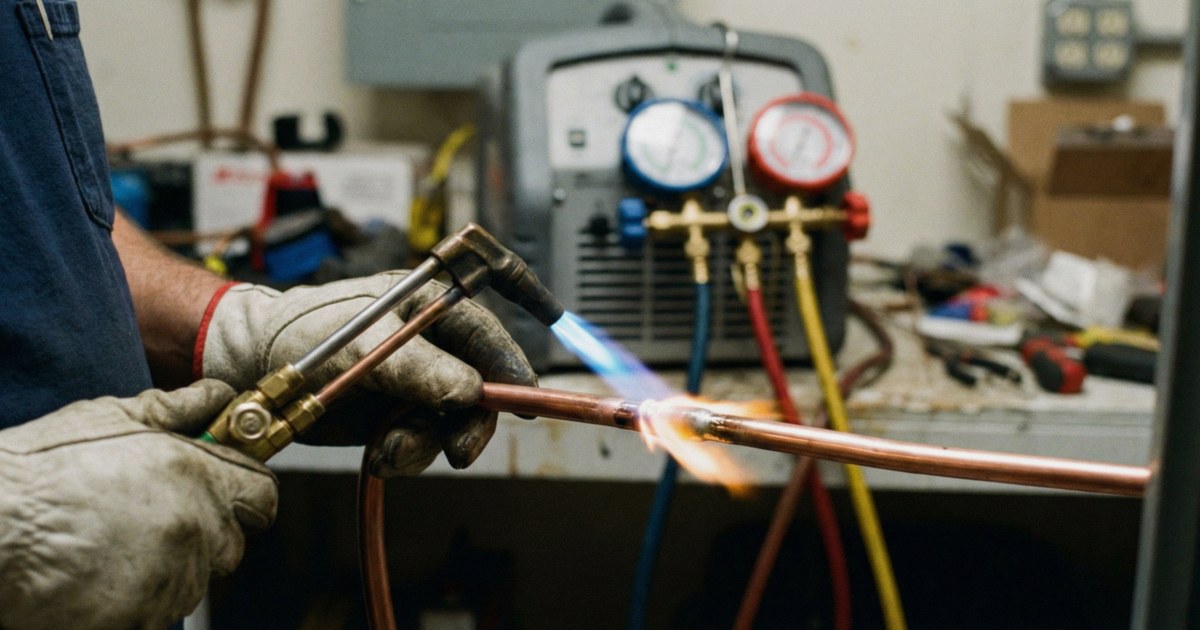
Brazing (sometimes loosely called silver soldering in the trade) joins copper refrigerant tubing using filler rod with a working temperature above 840°F. You use an oxy-acetylene or oxy-MAPP torch, and the quality of your joints determines whether the system holds pressure.
Poor brazing produces porous joints — the refrigerant leaks out over weeks or months, and the customer is back with the same problem. Good brazing produces consistent, leak-free joints that last the life of the equipment.
Learning brazing requires practice on scrap tubing. The technique involves:
- Proper tubing preparation (deburring, cleaning)
- Correct torch flame adjustment (neutral flame, not oxidizing or reducing)
- Nitrogen purge through the tubing while brazing (prevents scale formation inside the tubing)
- Correct filler rod and flux selection for the alloy and application
- Reading tube color temperature rather than relying on visual filler flow
The nitrogen purge is non-negotiable. Brazing copper tubing without nitrogen purge creates copper oxide scale inside the tubing. That scale eventually breaks loose, circulates with the refrigerant, and plugs metering devices or compressor valves. I've cleaned up sealed system failures caused by another tech's unpurged braze joints.
SilFos vs. Stay-Silv: SilFos alloy (15% silver, phosphorus-bearing) is self-fluxing on copper-to-copper joints and is the most common choice. Stay-Silv (45% silver) is used for copper-to-brass or copper-to-steel joints and requires separate flux. Know which application you're doing before you pick up the rod.
Recovery, Evacuation, and Recharge
Recovery: Before opening any refrigerant circuit, you must recover the refrigerant using a certified recovery machine. You cannot vent it. Connect the recovery cylinder and machine, open the valves, and recover until the system pressure reads 0 PSIG (and ideally goes slightly negative on the gauge). Document the recovered amount.
Evacuation: After the repair is complete and the system is closed, you pull a vacuum using a two-stage vacuum pump to remove air and moisture from the system. Target: below 500 microns (ideally 250 microns or less), verified with a micron gauge. Not a manifold gauge — a micron gauge. Manifold gauges read in PSI and cannot verify deep vacuum. A digital micron gauge is a mandatory tool for this work.
Time matters during evacuation. A system with long tubing runs or a recently brazed joint with residual moisture needs a full evacuation, not a 10-minute pull. For residential refrigerators with typical tubing lengths, 30-45 minutes at a strong pump with no leaks produces a reliable vacuum. Let the vacuum hold for 15 minutes after the pump is isolated — if it rises above 500 microns within 15 minutes, you have a leak or residual moisture.
Recharge: After confirmed vacuum, charge the system with the specified refrigerant type and amount. The spec is on the unit's nameplate — follow it exactly. Overcharging is as damaging as undercharging. Weigh the refrigerant in on a refrigerant scale for accuracy. Sight-glass-based charging methods are acceptable for some applications, but weighing in is more precise and appropriate for tight-tolerance residential refrigerators.


Refrigerant Types You'll Encounter in Refrigerators
R-134a: The dominant refrigerant in household refrigerators from approximately 1994 through the mid-2010s. HFC, non-flammable, non-ozone-depleting. Still common in the field on units that age. Standard sealed system procedures apply.
R-600a (isobutane): An increasingly common refrigerant in newer, more efficient refrigerators. Used in most Samsung, LG, and Bosch refrigerators manufactured from approximately 2015 onward. Natural refrigerant, very low global warming potential. The challenge: it's flammable (A3 classification).
R-600a sealed system work requires:
- Combustible gas leak detectors (standard HFC detectors will not detect it)
- Adequate ventilation — minimum air changes specified by local code for working with flammable gases
- Explosion-proof vacuum pumps and recovery equipment
- No open flames, sparks, or hot work near the work area during handling
The charge size on R-600a refrigerators is typically small (1.5-4 oz) because R-600a has very different pressure-enthalpy characteristics than R-134a. A small refrigerant release is generally below the lower flammable limit in a ventilated space, but this is not something to be casual about. Treat it with respect.
R-410A, R-32, R-454B: Primarily HVAC and mini-split refrigerants, covered under Type II or Universal certification.
When to Refer Out
Sealed system repair has a meaningful failure rate — partly from the inherent difficulty of finding and permanently sealing refrigerant leaks, partly from the skill variability in the technician pool. I think every tech doing sealed system work should have clear, pre-established referral criteria rather than taking every job and hoping.
Refer out when:
- The evaporator or condenser leak is embedded in foam insulation. Accessing these requires cutting foam, which compromises the unit's insulation and structural integrity. The repair is often not practical on consumer-grade equipment.
- The unit uses R-600a and you don't have combustible gas equipment. Improvising with R-134a equipment on an R-600a system is a fire and safety hazard. If you don't have the right tools, decline.
- The compressor is an inverter type and you lack diagnostic equipment. See our inverter compressor technology guide for why conventional diagnostic approaches don't work on these systems.
- The total repair cost approaches unit value. A sealed system repair — leak finding, brazing, evacuation, recharge, compressor replacement if needed — costs $400-900 on a residential refrigerator. A 15-year-old refrigerator worth $200 on the used market doesn't justify this economically. Be honest with customers.
- You don't have the tools to confirm vacuum depth. "I pulled vacuum for 20 minutes" with a manifold gauge is not a completed evacuation. If you don't own a micron gauge, don't do sealed system work.
Declining the job protects the customer from a poor repair and protects you from a warranty callback on work that didn't hold. There's no shame in a referral.
For broader refrigerator cooling diagnostics — identifying whether you're dealing with a sealed system issue or something more accessible — see our guides on LG refrigerator linear compressor failure and refrigerator not cooling.
Do I need EPA 608 certification to work on refrigerator sealed systems?▾
Yes. EPA Section 608 certification is required to purchase refrigerants in quantities above the small can exemption and to perform any work that involves intentional venting of refrigerant. Household refrigerators are small appliances (hermetically sealed with 5 lbs or less of refrigerant), so Type I (small appliances) or Universal certification is required. Working on refrigerant systems without proper certification is an EPA violation; Clean Air Act civil penalties are inflation-adjusted annually under 40 CFR 19.4 (the per-day, per-violation maximum was $44,539 in the 2018 adjustment, and current figures are higher).
How do you find a refrigerant leak in a refrigerator sealed system?▾
Start with a visual inspection of all accessible tubing for oil staining — refrigerant oil escapes with the refrigerant at a leak point. Then use an electronic leak detector along all joints, the evaporator, and the condenser. Nitrogen pressure testing at 100-150 PSI with a soap solution confirms small leaks. R-600a systems require a combustible gas-rated detector.
When should a sealed system repair be referred out rather than attempted?▾
Refer out when: the unit uses R-600a and you lack flammable-refrigerant-rated equipment, the leak is in the evaporator embedded in foam, the compressor is an inverter type requiring specialized diagnostics, or the total repair cost approaches the unit's value. Sealed system work has a meaningful failure rate — an honest shop knows when the math doesn't work for the customer.
Need a repair professional?
Get free quotes from verified technicians in your area.
Find a Pro Near YouSources
U.S. Environmental Protection Agency. "Section 608 Technician Certification Requirements." EPA Stratospheric Ozone Protection. https://www.epa.gov/section608/section-608-technician-certification-requirements
U.S. Environmental Protection Agency. "Refrigerant Sales Restriction." EPA Section 608. https://www.epa.gov/section608/refrigerant-sales-restriction
U.S. Environmental Protection Agency (2016). "Protection of Stratospheric Ozone: Update to the Refrigerant Management Requirements Under the Clean Air Act." Federal Register, 81 FR 82272, November 18, 2016. https://www.federalregister.gov/documents/2016/11/18/2016-24215
40 CFR 19.4 — "Statutory civil monetary penalties, as adjusted for inflation, and tables." Electronic Code of Federal Regulations. https://www.ecfr.gov/current/title-40/chapter-I/subchapter-A/part-19/section-19.4