


Washing Machine Not Spinning: Complete Diagnostic Guide for Top-Load and Front-Load Washers
Terry Okafor
Master refrigeration tech and NATE-certified instructor who moonlights as the magazine's advice columnist. His 'Ask Big Terry' mailbag has been settling shop disputes and diagnosing mystery leaks since 2011.
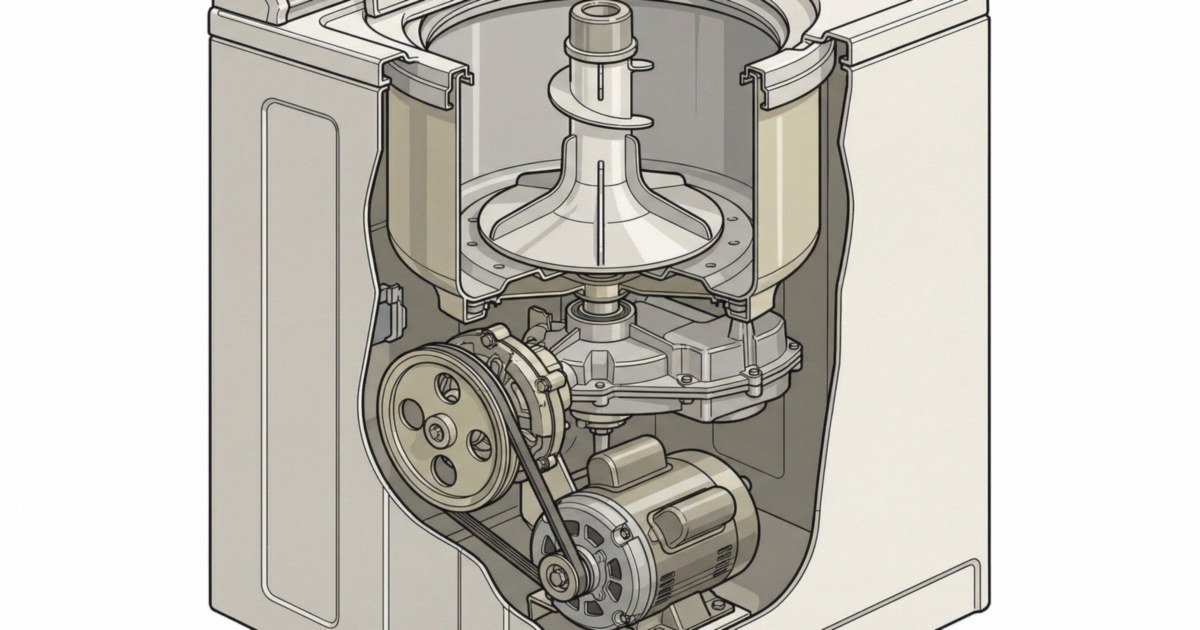
A washing machine not spinning is one of the most common service calls in residential appliance repair. The customer tells you the machine fills and washes fine but the clothes come out soaking wet. The spin cycle either doesn't engage at all or engages briefly and stops. Here's the systematic approach that finds the problem quickly without wasted parts.
Top-load and front-load machines fail differently, so I've split the diagnostic accordingly. Start with the section that matches your machine type.
Top-Load Washers: Diagnostic Sequence
The Lid Switch (Check First)
The lid switch is the safety device that prevents the washer from spinning when the lid is open. It's mounted under the top panel, near the lid hinge or at the front of the cabinet, with a plunger that the lid depresses when closed. When it fails — and it fails regularly, usually by losing continuity in the closed position — the machine won't enter spin mode regardless of everything else.
Quick test: on most top-loaders, you can manually depress the lid switch plunger while the machine is running. If the motor engages and the tub spins, the lid switch is the problem. If nothing happens when you depress the switch, the issue is elsewhere.
Test with a multimeter: disconnect the switch and check continuity in the activated (lid-closed) position. Should be nearly zero ohms. Open reading = bad switch.
Lid switch part numbers:
- Whirlpool/Kenmore/Maytag (direct-drive platforms, WTW and MVWB series): WP3949238 — covers most top-load platforms built since the mid-1990s
- Maytag Bravos (MEDB, MVWB MVWC series): W10404050 — this is the newer rocker-style switch used on the Bravos platform
- Samsung top-load (WA45, WA50, WA54 series): DC64-00828B — Samsung uses a lid lock switch assembly rather than a simple switch; failure often shows as LE or dS error codes
- LG top-load (WT7100, WT7400 series): AEQ73110203 — LG top-loaders use a lid lock assembly with a bi-metallic locking element
The Motor Coupling (Direct-Drive Top-Loaders)
Direct-drive top-loaders — Whirlpool, Kenmore, Maytag, and Roper platforms built from roughly 1990 to present — use a motor coupling to connect the motor shaft to the transmission input. The coupling has a plastic center block that's intentionally designed to fail under overload, protecting the motor and transmission from damage.
When the coupling fails, the motor runs (you can hear it) but the transmission doesn't receive the drive force. No agitation, no spin. Or partial agitation (the coupling slips but doesn't completely break) and no spin.
The motor coupling is accessible by removing the cabinet front panel. It's a 15-minute part swap if you've done it before. The plastic center piece breaks into two or three pieces — you'll find the debris in the cabinet when you open it up.
Part: WP285753A (formerly 285753A) — this single part number covers the motor coupling for virtually every Whirlpool-platform direct-drive top-loader for the last 30 years. Keep several on the truck.
A broken motor coupling almost always means the machine was overloaded repeatedly — too many jeans, too much bedding, unbalanced loads. Before you close the ticket, tell the customer: the new coupling will break too if they keep overloading the machine. The fix is permanent only if load size is managed. This is the kind of advice that turns a one-time repair into a long-term customer relationship.
The Clutch Assembly
The clutch is what allows the machine to ramp up gradually into the spin cycle rather than lurching from zero to full RPM. On Whirlpool-platform top-loaders, the clutch sits on the transmission output shaft and engages the spin basket. When the clutch wears, the machine may not spin at all, spin weakly, or spin intermittently.
The tell: a burning rubber or plastic smell during the spin cycle, or visible wear debris (black powder) inside the cabinet. The transmission shaft and clutch area will be coated with the wear material.
Part: 285785 — covers the clutch kit for most Whirlpool/Kenmore/Maytag direct-drive top-loaders. The kit includes the clutch pad and brake pad as a set. Replace both at once.
Samsung Top-Load: The Hall Sensor
Samsung's top-load washers use a hall sensor (rotor position sensor) to monitor the spin speed of the motor. When it fails, the control board can't confirm the motor is spinning correctly and the machine may halt mid-cycle or refuse to enter spin mode at all. Error codes: UE, E7, or EA on Samsung models.
Part: DC93-00542A or DC96-01518A depending on platform and production year. Check the model sticker inside the door frame. Confirm this part number against the model and serial before ordering — these vary by platform.


Front-Load Washers: Diagnostic Sequence
The Door Latch
Front-load washers won't spin — or do anything — if the door latch assembly doesn't confirm the door is locked. The latch has a mechanical lock and a microswitch or Hall effect sensor. If either fails, the machine may show a door lock error (dE, F/H, or Door Lock light) or simply refuse to start.
Quick test: listen for the click and slight mechanical delay (the bi-metallic element locking the door) when you close the door and start a cycle. If the machine doesn't respond at all after the door close, the latch is prime suspect.
Door latch part numbers:
- Whirlpool/Maytag front-load (WFW series): WPW10619033 — covers most WFW8100, WFW8200, WFW9400 and similar platforms. Confirm this part number against the model and serial before ordering — these vary by platform.
- Samsung front-load (WF42, WF45, WF50 series): DC64-00519B — Samsung latch failures often trigger dL or dE error codes
- LG front-load (WM3500, WM3600, WM3997 series): 6601ER1004C — LG latch assembly including the hall sensor element
The Drive Belt
Front-load washers use a drive belt from the motor to the drum. When the belt breaks or slips off the pulleys, the drum doesn't move. The motor runs but there's no drum rotation at all — not even tumbling during the wash phase.
Diagnosis: remove the back panel (on most models) and check the belt visually. A broken belt will be obvious. A slipped belt is less obvious — it may be sitting in the drum housing rather than on the pulley.
Belt part numbers:
- Whirlpool/Maytag front-load: WPW10006384 — fits most WFW platforms
- Samsung front-load (WF42, WF45): 6602-001655 — Samsung belts tend to slip before they break outright; inspect the pulley for wear if the belt keeps slipping
- LG front-load (WM series): 4400EL2001A — longer belt used on LG drum configurations
Suspension Rods and Shock Absorbers
If the machine spins but shakes violently and stops mid-spin, the suspension is worn. Front-loaders use shock absorbers at the bottom of the tub frame; top-loaders use suspension rods or springs. When these wear, the tub moves beyond its design limits during spin, the machine detects the imbalance, and halts the cycle.
The test: with the machine empty, manually push the tub left and right. More than 1-2 inches of movement and the suspension is shot. On top-loaders, look at the suspension rods — if the plastic cap at the top is worn flat or broken, it's time.
For Whirlpool top-loaders: suspension rod kit W10820048 (4-rod kit). For LG front-loaders: shock absorber pair AGL73951703. Samsung front-loaders: DC66-00343H (pair).
Control Board (Last Resort)
Both Samsung and LG front-loaders have a known failure mode where the control board's motor driver triac or relay fails, preventing the spin cycle from engaging even though all mechanical components test good. On Samsung WF45/WF50 series, the DC92 board revision is well-documented. On LG WM series, the EBR board series.
Before condemning the board, always verify the motor itself isn't shorted. Disconnect the motor and check winding resistance. An open or shorted motor winding will destroy a new board. Test the motor first.
For related context on washer drain problems that can also prevent spin engagement, see our guide on the Maytag F21 drain error. And if the issue is a suspected washer drain problem on other brands, see washer not draining.
Why is my washing machine not spinning?▾
The most common causes are a failed lid switch or door latch (preventing spin mode from engaging), a broken motor coupling (direct-drive top-loaders), a worn clutch assembly, or a broken drive belt. On Samsung and LG front-loaders, hall sensor failure is also common. Start with the lid switch or door latch — it's the most frequent culprit and the cheapest fix.
How much does it cost to fix a washing machine that won't spin?▾
Lid switch or door latch replacement: $150-250 total. Motor coupling: $175-250. Clutch assembly: $200-325. Drive belt: $125-200. Suspension repair: $175-300. Control board on Samsung or LG: $300-500.
Why does my washer stop spinning mid-cycle?▾
A washer stopping mid-spin is typically detecting an out-of-balance load and pausing to redistribute. If moving the load doesn't fix it, check the suspension rods (top-load) or shock absorbers (front-load) — worn suspension causes excessive tub movement that triggers the balance sensor. Also check the lid switch for intermittent contact.
My top-load washer agitates but won't spin — what's wrong?▾
On Whirlpool, Maytag, and Kenmore direct-drive top-loaders, agitation without spin is the classic broken motor coupling symptom. The coupling's plastic center block breaks — you may find black debris inside the cabinet. Part WP285753A fits virtually every Whirlpool-platform direct-drive machine. It's a $10 part and about an hour of labor.
Need a repair professional?
Get free quotes from verified technicians in your area.
Find a Pro Near You