


AI Fault Detection Delivers Real Energy Savings Across 42 Operating Chillers

Dale Resnick
A 30-year veteran of residential HVAC who's crawled through more attics than he can count.
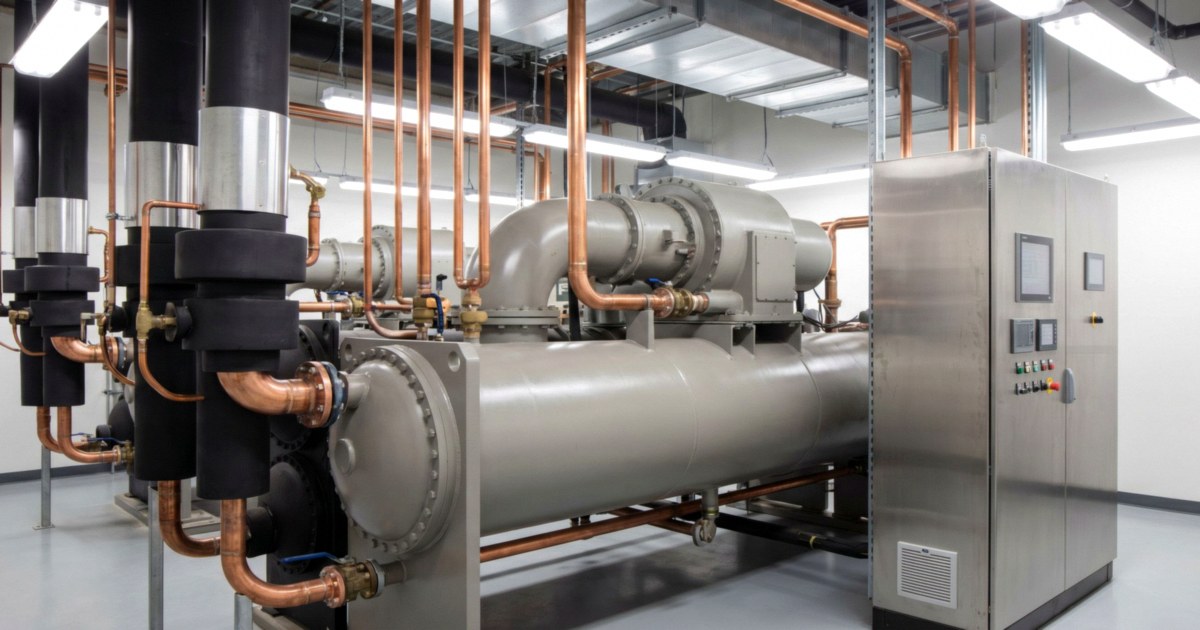
Chiller fault detection research usually comes wrapped in simulation caveats: the model worked beautifully on synthetic data, your mileage may vary on real equipment. A study out in Case Studies in Thermal Engineering (2025) finally breaks that pattern.
Researchers deployed a 1D Convolutional Neural Network with transfer learning fault-detection system across 42 operating chillers in Taiwan over three years. Not a test bench. Not a simulation. Live commercial equipment, running production cooling loads, under real maintenance conditions. The system hit 93% accuracy on three major fault types and — this is the part that matters for contractors — produced quantified kW-per-ton energy savings documented through the deployment.
Empirical evidence of AI-driven fault detection paying back on live jobsites has been the missing piece. This fills it.
What the Deployment Actually Tested
The 1D-CNN architecture is built to recognize patterns in time-series sensor data: compressor amp draw, evaporator approach temperature, condenser saturation, flow rates, and their relationships over time. Transfer learning let the team train the base model on one set of chillers and fine-tune it for the others without starting from zero each time.
The 93% accuracy figure is on three specific fault types the researchers focused on — the kind of degrading-performance failures that cost facilities energy before they trigger a trouble alarm. Refrigerant undercharge, fouled condenser tubes, and inefficient part-load operation all show up in BMS data if you know how to look. The model does the looking.
What distinguishes this from dozens of similar academic papers is the three-year live deployment. Researchers weren't testing whether the model could identify faults in theory. They were documenting what happened to energy consumption on real chillers running real loads when faults were caught and corrected earlier than a human operator would have caught them.


Translating to a Service Contract
For commercial HVAC contractors bidding chiller service, the research gives a new pitch structure. Instead of "we inspect quarterly and you hope nothing breaks," the offer becomes "we monitor continuously, flag degrading performance before it costs you kW per ton, and document the savings."
If you service chillers, ask each building owner for their monthly kW/RT number. Most operators don't track it. Getting that baseline established is both a sales conversation and the foundation for any future AI-driven service agreement.
Facilities managers running big cooling loads — data centers, hospitals, large office campuses — already know that a chiller running at 0.65 kW/RT versus 0.58 kW/RT adds up to six-figure annual electricity differences on a single machine. Early fault detection that moves a chiller back toward spec is money. Quantifying that in a service contract with empirical backing is what separates a premium service partner from a commodity maintenance vendor.
Said plainly: the research is the sales tool.
One careful note. The deployment ran on Taiwanese chillers, which skew toward certain manufacturer profiles and maintenance practices. American chiller fleets and climate profiles differ, and any contractor trying to replicate the results should expect accuracy to vary until the model is tuned on local equipment. The headline finding — that 1D-CNN with transfer learning produces measurable chiller energy savings on live equipment — is portable. The exact 93% figure may not be.
Commercial shops that stay on quarterly visual inspections in 2026 will keep competing with every other quarterly-inspection vendor in the market. Those that bring empirical AI fault detection, backed by peer-reviewed deployment research, to their next chiller service renewal have a story that sets their price above the floor.
See also: our reporting on smart-home integration for service pros and AI predictive maintenance in appliance service.
Source
Chen, Y.-T., Lee, D.-S., Yang, J.-J., Huang, W.-T., & Liu, Y.-P. (2025). "Energy saving by Artificial intelligence-based fault detection and diagnosis: 42 chiller case studies." Case Studies in Thermal Engineering, Vol. 74, Article 106885. https://www.sciencedirect.com/science/article/pii/S2214157X25011451
Need a repair professional?
Get free quotes from verified technicians in your area.
Find a Pro Near You