

California's Right to Repair Law Is Now in Effect. Here's What Techs Need to Know.
ServiceMag Staff
ServiceMag editorial team
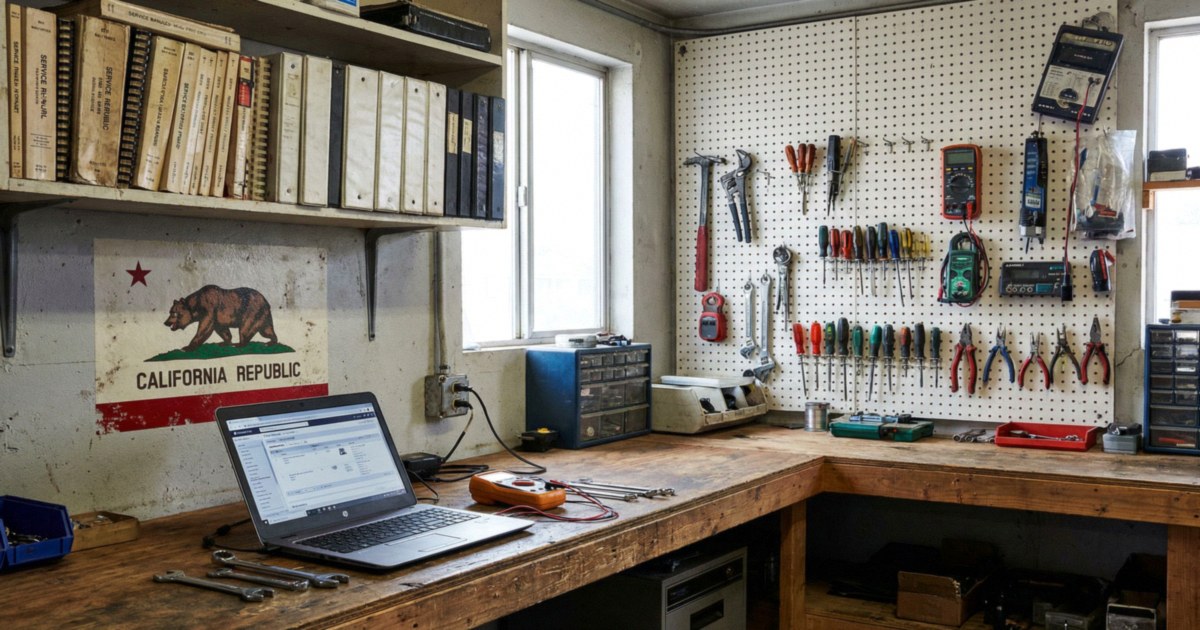
California's Senate Bill 244, one of the broadest right-to-repair laws in the United States, has been in effect since July 1, 2024. Nearly two years in, independent shops are starting to see real-world results — and real-world friction.
What SB 244 Actually Requires
The law applies to manufacturers of "electronic or appliance products" sold in California, and it sets coverage by the product's wholesale price in two tiers: products with a wholesale price of $50 to $99.99 are covered, and products with a wholesale price of $100 or more get a longer support window. (Products with a wholesale price under $50 are not covered.) The threshold is low enough that it sweeps in virtually every major appliance category.
Parts availability: Manufacturers must make replacement parts, tools, and documentation available to independent repair shops and owners for at least three years after the last date a product was manufactured for products with a wholesale price of $50 to $99.99, and for at least seven years for products with a wholesale price of $100 or more.
Documentation: Service documentation — including diagnostic procedures, error code definitions, and assembly/disassembly instructions — must be made available on the same terms as those offered to authorized service providers.
Tools and software: Diagnostic software and tools required to diagnose, repair, or calibrate the product must be made available to independent operators on fair and reasonable terms.
What's Changed for Independent Shops
Several major manufacturers have responded to SB 244 by expanding their parts portals and publishing service documentation previously restricted to their authorized networks.
Samsung expanded the scope of its Self-Repair portal, adding appliance categories that were previously available only to Samsung-authorized service centers. LG has made diagnostic software available to independent operators through its partner portal, with a nominal annual fee.
Whirlpool brands — including Maytag, KitchenAid, and JennAir — already had relatively open parts networks through distributors like Marcone and RepairClinic. For these manufacturers, SB 244's practical impact on parts access has been modest. The bigger change has been in documentation: factory service manuals that were once behind login walls are now required to be available on the same terms as those provided to Whirlpool-authorized shops.
The manufacturers with the most closed ecosystems before SB 244 — certain premium European brands, some smaller appliance makers — have shown the most resistance to full compliance. The California Attorney General's office has enforcement authority, but the mechanisms are still being tested.
The Diagnostic Tools Problem
Parts and documentation are the clearer wins. Diagnostic tools are proving to be harder.
Several manufacturers have interpreted "fair and reasonable terms" for diagnostic software in ways that independent shops find anything but. Shops we spoke with described annual licensing fees for software that authorized dealers receive as part of their dealer agreement, and some brands requiring monthly subscriptions with no option for per-job access. We were not able to independently verify specific fee figures across manufacturers, and terms vary widely by brand and product line.
The law does not specify a maximum price for parts or tools — it requires that they be offered on "fair and reasonable" terms compared to what authorized service providers receive. Enforcement of that standard requires complaints, investigation, and ultimately legal action. For now, independent shops may find some tools technically available but practically expensive.
Even with imperfect compliance on diagnostic software, SB 244 has improved the information landscape for independent techs. If a manufacturer's service documentation is behind a paywall that's substantially more expensive than what authorized dealers pay, document it and report it to the California Attorney General's office. Enforcement relies on shops reporting violations — the law only works if it's enforced.


OEM vs. Independent Shop Relationship: What's Shifting
One subtler effect of SB 244 is on the OEM-to-independent-shop relationship itself. Manufacturers who previously had no business reason to work with independent operators are now required to do so. That creates an opening.
Several shops in Southern California have told us they've been able to negotiate supplier-adjacent relationships with manufacturer reps as a result of SB 244 — not authorized dealer status, but better parts pricing and access than the open market. The leverage comes from the legal requirement: if the manufacturer has to provide access anyway, some are choosing to channel it through relationships that give them some visibility into independent repair activity.
What Techs Should Do Now
Request documentation you've been denied. If a manufacturer previously told you that service documentation was restricted to authorized shops, request it now. Cite SB 244 if the request is refused. Most manufacturers' compliance teams will respond to a formal request citing the law.
Know the parts availability windows. The parts availability requirement — three years for products with a wholesale price of $50 to $99.99, seven years for products with a wholesale price of $100 or more — starts from the last date a product was manufactured, not the sale date. For a model still in production, the clock hasn't started. For discontinued models, know when manufacturing ended so you can anticipate when parts access may end.
Use third-party parts where OEM isn't available. SB 244 requires manufacturers to provide OEM parts access, but it does not prohibit the use of third-party parts. For models where OEM compliance is still contested, quality aftermarket parts remain a legal option.
Track parts ordering experiences. If a manufacturer refuses a parts order, delays fulfillment substantially compared to authorized dealers, or quotes pricing dramatically above market rates, that's a potential SB 244 violation. Track these instances.
The Bigger Picture
SB 244 is one of the broadest right-to-repair laws in the country, though it wasn't the first — New York's Digital Fair Repair Act took effect December 28, 2023, and Minnesota's law became effective July 1, 2024, the same day as California's. California's legislation often sets the national template, and similar bills have passed or are moving in Oregon, Minnesota, and New York. The industry-wide shift toward manufacturer software control of diagnostics — a trend we covered in our analysis of how smart appliance diagnostics are changing service calls — is exactly the kind of ecosystem control that right-to-repair legislation is designed to counter.
Nearly two years in, SB 244's impact is real but uneven. The well-resourced manufacturers with existing parts networks are mostly compliant. The most closed ecosystems remain partially resistant. The enforcement mechanism is complaint-driven, not proactive. For now, independent shops in California have more legal leverage than they've ever had — using it requires knowing the law and applying it.
Need a repair professional?
Get free quotes from verified technicians in your area.
Find a Pro Near YouSource
California State Legislature. (2023). "SB-244 Right to Repair Act." 2023–2024 Regular Session. leginfo.legislature.ca.gov